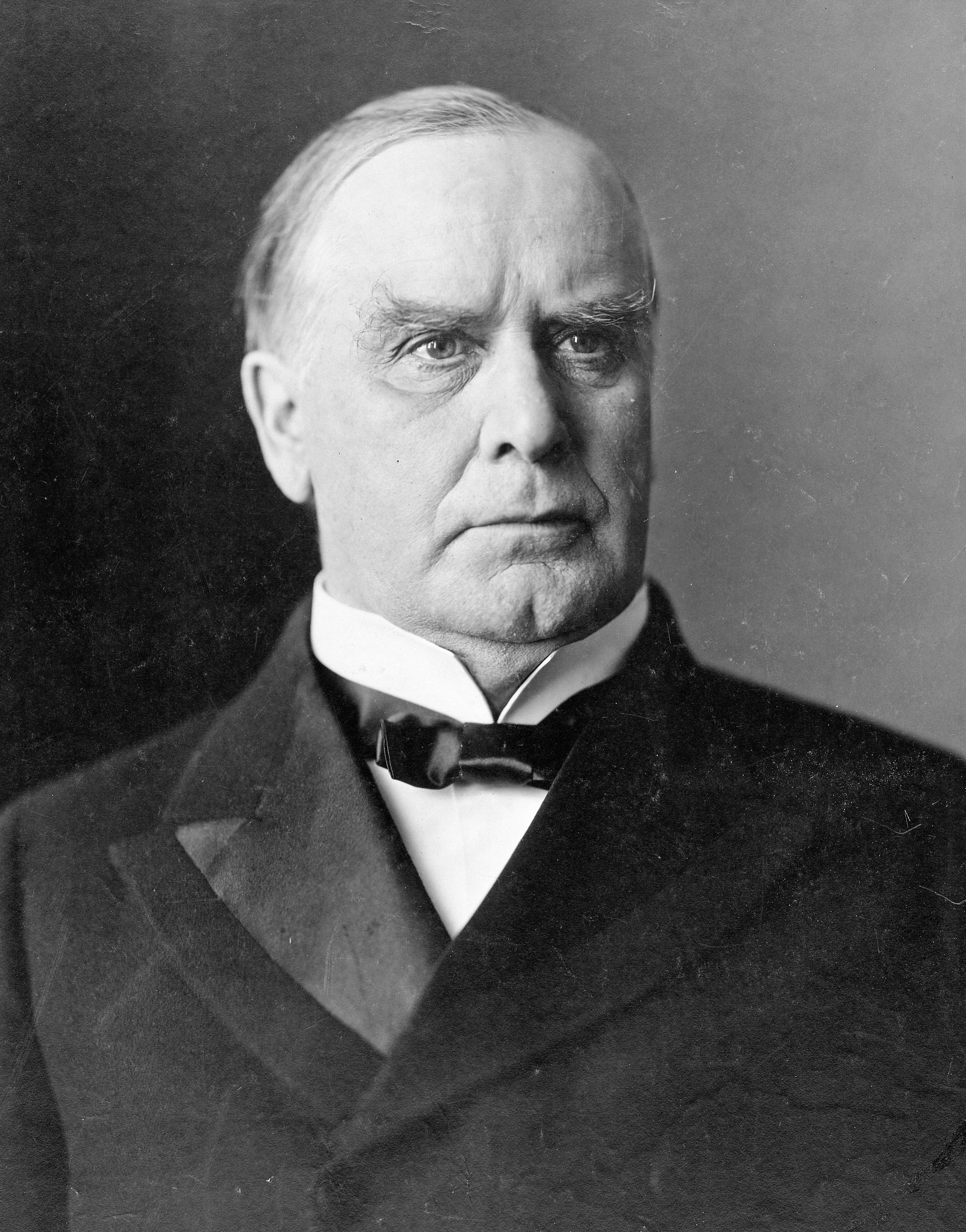
January 29, 1843 - William McKinley
McKinley appears on this site not for his own crimes but as a subject of political assassination — the third American president killed in office, shot by anarchist Leon Czolgosz at the Pan-American Exposition in Buffalo in September 1901. His death shaped the course of American history by elevating Theodore Roosevelt to the presidency, redirecting the nation's political trajectory. The circumstances of the killing — a public event, a handshake line, a concealed weapon — also prompted lasting changes to presidential security.
From Wikipedia
William McKinley (January 29, 1843 – September 14, 1901) was the 25th president of the United States, serving from 1897 until his assassination in 1901. A member of the Republican Party, he led a realignment that made Republicans largely dominant in the industrial states and nationwide for decades. McKinley successfully led the U.S. in the Spanish–American War and oversaw a period of American expansionism, with the annexations of Hawaii, Puerto Rico, Guam, the Philippines, and American Samoa.
McKinley was the last president to have served in the American Civil War; he was the only one to begin his service as an enlisted man and end it as a brevet major. After the war, he settled in Canton, Ohio, where he practiced law and married Ida Saxton. In 1876, McKinley was elected to Congress, where he became the Republican expert on the protective tariff, believing protectionism would bring prosperity. His 1890 McKinley Tariff was highly controversial and, together with a Democratic Party redistricting aimed at gerrymandering him out of office, led to his defeat in the Democratic landslide of 1890. He was elected governor of Ohio in 1891 and 1893, steering a moderate course between capital and labor interests.
- Last updated on .