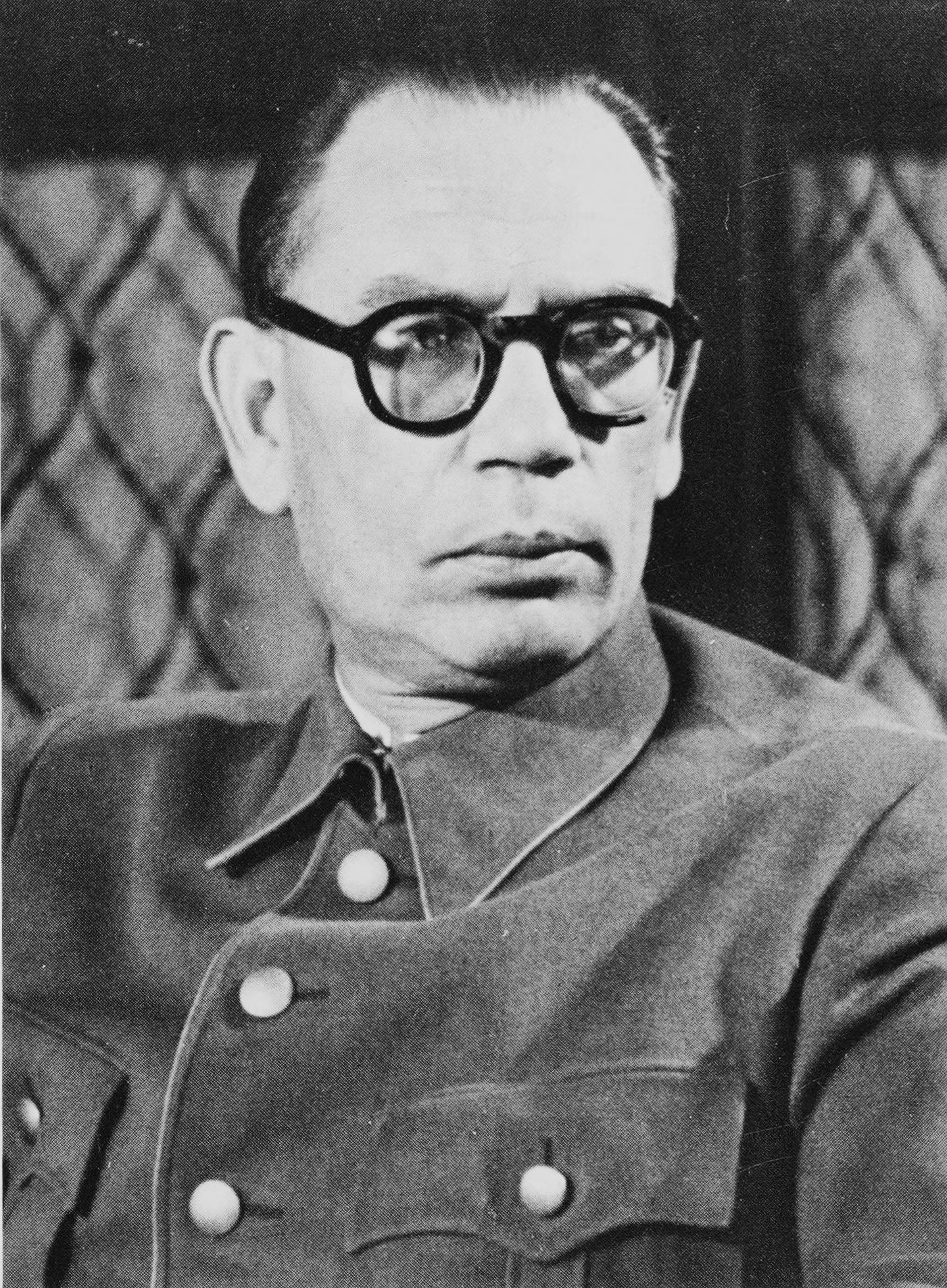
May 12, 1901 - Andrey Vlasov
Vlasov occupies an uncomfortable place in the history of the Eastern Front — a decorated Red Army general who, after capture in 1942, became the most prominent Soviet defector to collaborate with Nazi Germany. His case is complicated by evidence that he and his associates were less committed to Nazi ideology than to an anti-Stalinist political program, yet the movement he led was used primarily as a German propaganda instrument for most of the war. The tension between his stated aims and the machinery he was forced to work within has made him a contested figure: traitor, opportunist, or failed dissident, depending on the frame applied. He was tried and executed by the Soviet state in 1946.
From Wikipedia
Andrey Andreyevich Vlasov (Russian: Андре́й Андре́евич Вла́сов, September 14 [O.S. September 1] 1901 – August 1, 1946) was a Soviet Russian Red Army general. During the Axis-Soviet campaigns of World War II, he fought (1941–1942) against the Wehrmacht in the Battle of Moscow and later was captured attempting to lift the siege of Leningrad. After his capture, he defected to the Third Reich and nominally headed the collaborationist Russian Liberation Army (Russkaya osvoboditel'naya armiya, ROA), also becoming the political leader of the Russian collaborationist anti-Soviet movement.
Initially, this army existed only on paper and was used by Germans to goad Red Army troops to surrender, while any political and military activities were officially forbidden to him by the Nazis after his visits to the occupied territory; only in November 1944 did Heinrich Himmler, aware of Germany's shortage of manpower, arrange for Vlasov's formations, composed of Soviet prisoners of war as armed forces of Committee for the Liberation of the Peoples of Russia, a political organisation headed by Vlasov. While for the Nazis the ROA was a mere propaganda weapon, Vlasov and his associates attempted to create an armed political movement independent of the Nazi control that would present an anti-Stalinist program described by Robert Conquest as democratic, while attempting to avoid Nazi antisemitism and chauvinism, with "completing the Revolution" of 1917 being the ultimate goal of the movement.
In January 1945, Vlasov headed the army as it was declared that it would be no longer a part of the Wehrmacht. At the war's end, the 1st division of ROA aided the May 1945 Prague uprising against the Germans. Vlasov and the ROA were captured by Soviet forces with the United States' assistance.
- Last updated on .